

What if the biggest obstacle to building a discipleship relationship isn’t a lack of theological training, but the belief that you need a PhD to start? It’s a common struggle. You want to help someone grow, yet you’re held back by the fear of not having all the answers or the worry that things will get awkward after the third meeting. You aren’t alone in feeling overwhelmed by the time commitment or the pressure to be perfect.
We believe that every believer is called and equipped to lead. This article will help you move past the fear of inadequacy and build a purposeful, life-changing discipleship relationship using a proven biblical framework. We’ll debunk five persistent myths that are stalling your mission in 2026. You’ll gain the confidence to initiate the conversation and discover tools, like our mobile app and structured 25-week course, that keep your meetings focused on spiritual growth. By the end, you’ll have a clear roadmap for your first six months of mentoring and the tools to keep the relationship on track.
Key Takeaways
- You don’t need a theological degree to start. Learn why your current journey is exactly what someone else needs to see.
- Master the art of building a discipleship relationship by moving from casual conversations to purposeful spiritual partnerships.
- Adopt a proven rhythm that balances deep connection with a clear roadmap for your first six months.
- Use the Make Disciples Mobile App and 25-Week Discipleship Course as a safety net. These tools keep your meetings focused.
- Explore the “Relational DNA” of Jesus’ ministry to prioritize your time for maximum spiritual multiplication.
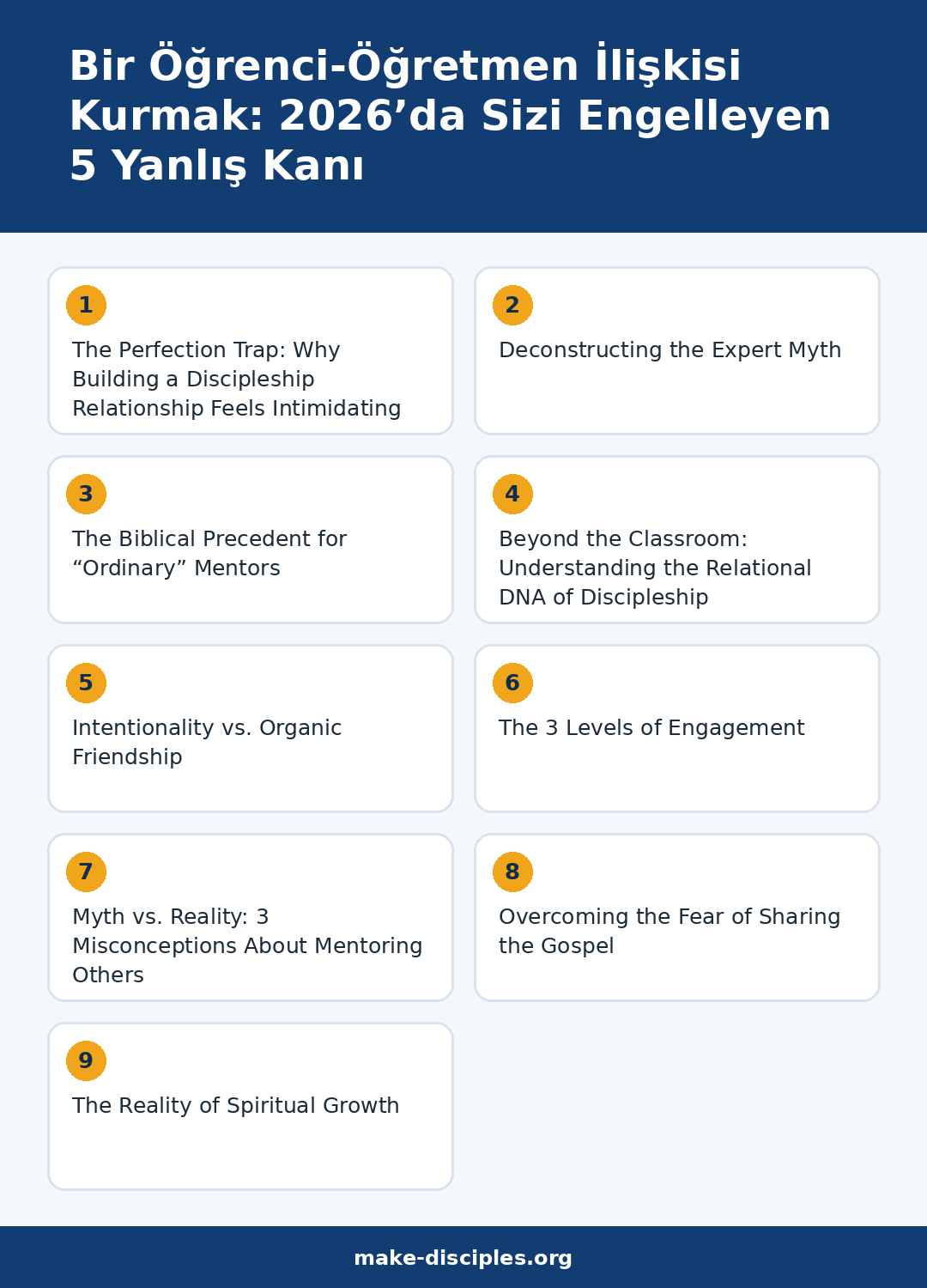
The Perfection Trap: Why Building a Discipleship Relationship Feels Intimidating
Many believers hesitate to mentor others because they feel they aren’t holy enough or smart enough. This is the perfection trap. It stops the Great Commission in its tracks before it even begins. We often wait until we feel like “experts” before we reach out, but that day rarely comes. The truth is that building a discipleship relationship isn’t about one person having all the answers. It’s a purposeful partnership for spiritual multiplication where two people walk together toward Christ. To understand the core of this calling, it’s helpful to look at What is a Disciple in the broader Christian context. Simply put, a discipleship relationship is a journey of mutual following of Christ.
We often default to an “Expert-to-Student” model, which feels like a rigid classroom. This approach creates a hierarchy that can make the mentor feel pressured and the student feel inferior. However, a “Life-on-Life” approach is far more transformative. It’s about inviting someone into your daily walk, showing them how you pray, how you handle stress, and how you apply Scripture to real-world problems. When you focus on building a discipleship relationship through life-on-life connection, the pressure to be perfect vanishes. It’s replaced by the joy of shared growth.
Deconstructing the Expert Myth
Your struggles aren’t obstacles. They’re actually your greatest teaching tools. When you’re honest about your failures and how God’s grace met you there, you give the other person permission to be real too. There’s immense power in saying, “I don’t know the answer to that, but let’s find out together.” This humility moves you from being a passive observer of the faith to an active participant in the Great Commission. You don’t need a PhD to lead someone. You just need a willing heart and the courage to be vulnerable about your own journey with God.
The Biblical Precedent for “Ordinary” Mentors
The early church wasn’t built by scholars or the religious elite of the day. In Acts 4:13, the religious leaders were astonished by Peter and John because they were uneducated and ordinary men who had simply been with Jesus. Our Lord used a relational model rather than a formal classroom. He ate with His followers, traveled with them, and taught them in the context of everyday life. He showed us that the most effective way to change a life is through intentional, personal connection. You can learn more about this in our guide on What is Discipleship? A Biblical Foundation.
Beyond the Classroom: Understanding the Relational DNA of Discipleship
Jesus didn’t just give lectures; He shared His life. To follow His model, we have to look closely at how He managed His time and energy across four distinct levels of relationship. He had the inner circle of three (Peter, James, and John), the core group of twelve, the larger group of seventy-two, and finally, the crowds. Each level served a purpose, but His deepest investment happened in the smallest circles. When you’re building a discipleship relationship, you’re choosing to move someone from the crowd into your “three” or your “twelve.”
It’s vital to remember that the goal of this connection isn’t a simple transfer of information, but a total Christ-like transformation. You aren’t just a teacher handing out a syllabus. You’re a guide pointing to the true Life-Changer. While you provide the environment and the tools, the Holy Spirit is the one who does the heavy lifting of changing a human heart. Your role is to remain sensitive to His leading as you walk together. For a deeper look at how mentorship and spiritual growth intersect, you can read more about Christian Mentoring and its biblical roots.
Intentionality vs. Organic Friendship
Friendship is the foundation, but intentionality is the “secret sauce” that turns a casual hangout into a discipleship opportunity. There’s a fine line between just “hanging out” and discipling someone. Discipleship requires a clear destination. You don’t have to make it feel forced or awkward. Simply start by asking, “How can I pray for your spiritual growth this week?” or sharing what God taught you in your own quiet time. This small shift in focus ensures your time together has a kingdom purpose. If you’re worried about staying on track, you can explore our digital tools to help maintain that spiritual focus.
The 3 Levels of Engagement
Effective discipleship happens in different settings, each offering unique benefits:
- Intimate (1-on-1 or 1-on-3): This is where deep vulnerability happens. It’s the space for confession, hard questions, and personal correction.
- Personal (The Small Group): In this setting, you model godly behavior in a community. It’s a “lab” for practicing the “one anothers” of Scripture.
- Social (Shared Mission): Discipleship isn’t just about sitting in a coffee shop. It’s about going out together to serve, share the gospel, and engage in outreach.
By understanding these levels, you can be more strategic in building a discipleship relationship that lasts. You’ll move beyond the classroom and into the messy, beautiful reality of life-on-life ministry.
Myth vs. Reality: 3 Misconceptions About Mentoring Others
Internal barriers often shout louder than the call to go. You might feel like you’re unqualified because of your past, your personality, or your lack of experience. These mental hurdles keep many well-meaning believers on the sidelines. Let’s look at three common myths that stop people from building a discipleship relationship and replace them with biblical truth.
- Myth 1: “I need to have my life completely together first.” Reality: If you wait until you’re perfect, you’ll never start. God’s power is made perfect in weakness. Your current struggles and the way you lean on God’s grace are actually what a younger believer needs to see.
- Myth 2: “I have to be an extrovert or a natural leader.” Reality: Discipleship is built on faithfulness and listening, not charisma. Current research on mentoring relationships shows that developmental models, which focus on the relationship itself, are often more effective than prescriptive, top-down models.
- Myth 3: “Sharing the gospel is too scary to teach someone else.” Reality: You don’t need to be a professional evangelist. You just need to be a witness of what God has done for you. Teaching someone else actually reinforces your own confidence.
Overcoming the Fear of Sharing the Gospel
A common pain point for many is the feeling that “I can’t disciple because I’m afraid to evangelize.” It’s a valid concern, but it shouldn’t be a stop sign. In fact, a discipleship relationship provides the perfect environment to overcome the fear of sharing the gospel. When you’re walking with someone else, you can practice together, pray for each other’s neighbors, and step out in faith as a team. If you’re unsure where to begin, check out our guide on How to Start a Gospel Conversation: A 2026 Guide. You’ll find that the more you talk about Jesus with a friend, the more natural it becomes to talk about Him with a stranger.
The Reality of Spiritual Growth
Biblical growth isn’t about one person standing at the finish line shouting instructions to someone at the start. It’s about “walking alongside” in a way that models the Christian life in real time. This approach is more biblical than “leading from the front” because it emphasizes our shared need for Christ. Building a discipleship relationship requires the courage to practice biblical correction with grace. It means being honest enough to share your own struggles. This level of authenticity builds trust and shows the other person that spiritual maturity isn’t about the absence of struggle, but about the presence of faith in the midst of it.
The 4 Pillars of a Healthy, Long-Term Discipleship Connection
Most spiritual mentorships start with high energy but eventually stall in the “messy middle.” This happens when there is plenty of passion but very little process. To keep the momentum alive, you need a structure that supports growth without feeling like a rigid corporate meeting. Successfully building a discipleship relationship requires a foundation built on four essential pillars. These pillars provide the stability needed to move from a casual acquaintance to a deep, transformative partnership.
- Pillar 1: Clarify the Goal. Sit down and define what you are trying to accomplish. Are you working through a specific book of the Bible, or are you focusing on developing a particular ministry skill? Without a target, your time will lack direction.
- Pillar 2: Establish a Rhythm. Decide on the time, place, and frequency of your meetings. Consistency is the engine of spiritual growth.
- Pillar 3: Use a Structured Tool. Don’t rely on your own memory or wisdom alone. Using a curriculum removes the “what do we talk about today” guesswork and provides a safety net for new mentors.
- Pillar 4: Set a Trial Period. Commit to a short-term “test drive,” such as six weeks. This low-pressure approach allows both parties to see if the relationship is a good fit before committing to a longer journey.
Establishing the Rhythm and Limits
Frequency often matters more than duration. It is better to meet for forty-five minutes every week than to try for a three-hour marathon once a month. Regular touchpoints keep spiritual conversations fresh and allow for real-time accountability. However, you must also understand your limits. You are a mentor, not a licensed therapist or a crisis counselor. If the person you are discipling reveals deep clinical trauma or severe mental health struggles, be ready to refer them to professional care. Your primary role is spiritual guidance, which includes knowing how to lead someone to Christ if they are still exploring the foundations of the faith.
Selecting Your Training Framework
Aimless discipleship often turns into a social club where little growth occurs. To avoid this, select a training framework that balances deep biblical theology with practical ministry skills. A good course shouldn’t just fill a student’s head with facts; it should equip their hands for service. You can choose a self-paced approach for maximum flexibility or a group-paced model for added community support. If you want to ensure your meetings stay focused and productive, get started with a structured curriculum that guides you through the process step by step. This keeps the focus on building a discipleship relationship that results in actual multiplication rather than just a series of coffee dates.
Scaling Your Impact with Structured Discipleship Tools
The heart of ministry is relational, but the method benefits from a clear, repeatable structure. Many mentors start with great intentions only to find themselves stuck after a few months because they lack a path forward. This is where the right resources become a vital safety net. By using the Make Disciples 25-Week Discipleship Course, you remove the anxiety of the unknown. You don’t have to be a master theologian to lead someone well; you just need to be one step ahead and equipped with a reliable map. This structured approach is a vital step in building a discipleship relationship that doesn’t just survive the first month but thrives for a lifetime.
The 25-Week Roadmap
Our 25-week curriculum is designed to build ministry skills sequentially. It starts with the basics of the faith and moves toward active multiplication. This structure solves the #1 problem most mentors face: the fear of running out of things to talk about. Instead of wondering what to cover next Tuesday, you can focus on the person sitting across from you. The goal here isn’t just “knowing” more facts about the Bible. It’s about “becoming” a disciple-maker who can eventually lead others. Each week provides a natural progression, ensuring the person you’re discipling is being equipped for real-world ministry, not just classroom learning.
Digital Tools for a Modern Mission
Discipleship shouldn’t stop when you leave the coffee shop. While many traditional models treat spiritual growth as a purely analog activity, we believe in leveraging technology to facilitate ancient goals. The Make Disciples Mobile App keeps the relationship active between your weekly meetings. It provides 24/7 access to training materials, making it easy to stay connected even with a busy 2026 schedule. You can use the app to share prayer requests, practice scripture memory, and track progress in real time.
For the mentor, the App Manual serves as a constant companion, ensuring even those who aren’t tech-savvy can lead with confidence. These digital tools also facilitate global accessibility, allowing the same proven framework to be used across cultural and linguistic boundaries. This tech-forward approach gives you the confidence you need when building a discipleship relationship in a modern, mobile-first world. You can Download the Make Disciples App and start your first relationship today.
Your obedience to the Great Commission doesn’t require you to reach thousands at once. It starts with the simple, courageous act of investing in one person. When you’re equipped with the right tools and a humble heart, you’re ready to make an eternal impact. Don’t let the myths of inadequacy hold you back any longer. Step out in faith, use the resources available to you, and watch how God uses your “yes” to change a life forever.
Step Into Your Calling as a Disciple-Maker
You no longer have to let the fear of inadequacy or the lack of a plan keep you on the sidelines. We’ve seen that building a discipleship relationship isn’t about having a perfect life or a theological degree; it’s about walking alongside someone with intentionality and a clear destination in mind. By establishing a consistent rhythm and using the right pillars, you can move past the “messy middle” and see real spiritual transformation in others.
It’s time to trade your anxiety for action. You can equip yourself for the Great Commission with the Make Disciples 25-Week Course. This program provides 25 weeks of structured, biblical training that removes the guesswork from your meetings. Plus, our mobile app offers on-the-go ministry equipping, a tool already used by disciple-makers worldwide to keep their mission on track. Take the first step today. Your obedience starts with a single conversation, and we’re here to provide the safety net you need to lead with confidence.
Frequently Asked Questions
How long should a typical discipleship meeting last?
Aim for sixty to ninety minutes for your regular meetings. This timeframe provides enough space for a warm check-in, a focused study of the Word, and intentional prayer without feeling rushed. If you meet for less than an hour, you might stay on the surface of deep spiritual issues. If you go over two hours, fatigue often sets in for both parties. Consistency is more important than length, so pick a duration you can both maintain every week.
What if the person I am discipling is more spiritually mature than me?
You can still lead them effectively through a structured path. Discipleship isn’t about being a superior saint; it’s about being a facilitator of growth. Even if they have more Bible knowledge, you can provide the accountability and the framework they need to stay sharp. Using a tool like our 25-Week Discipleship Course helps keep the focus on mutual obedience to Christ rather than a hierarchy of maturity or intellect.
How do I gracefully end a discipleship relationship if it isn’t working?
Be honest and kind during a scheduled check-in meeting. It’s best to set a clear end date or graduation point from the very beginning to avoid awkwardness later. If things aren’t clicking, simply say, “I’ve enjoyed our time, but I think our current season of intensive mentoring is coming to a close.” Help them find a new group or mentor so they don’t feel abandoned in their spiritual journey. This keeps the exit purposeful and supportive.
Can I disciple more than one person at a time?
Yes, and Jesus often did this with His inner circle of followers. Small groups of two or three people can actually be more effective than one-on-one meetings because they provide diverse perspectives and robust accountability. When you are building a discipleship relationship with a small group, it takes the pressure off you to be the sole source of wisdom. Just ensure you have enough time to invest deeply in each person’s individual growth.
What are the best Bible verses to start with in a new discipleship relationship?
Start with the foundations of our identity and our mission in the world. Matthew 28:18-20 is essential for understanding why we make disciples. John 15:1-11 helps establish the need for abiding in Christ as the source of all spiritual fruit. You might also look at 2 Timothy 2:2 to emphasize the goal of spiritual multiplication. These verses provide a clear biblical “why” for the time you spend together and set the tone for your partnership.
How do I handle it if they ask a theological question I can’t answer?
Admit it immediately and offer to research the answer together. Saying “I don’t know, but let’s find out” is a powerful way to model humility and a hunger for truth. Use your study tools or the Make Disciples Mobile App to look for answers before your next meeting. This turns a moment of potential embarrassment into a shared learning experience that strengthens the bond between you. It shows that you are both students of the Word.
Is it okay to disciple someone of the opposite gender?
We strongly recommend discipling someone of the same gender. While we are all brothers and sisters in Christ, building a discipleship relationship requires a level of deep vulnerability and transparency that is best shared between men with men or women with women. This practice protects everyone involved, avoids potential misunderstandings, and allows for specific, life-on-life application of biblical truth that is often gender-specific. It creates a safer environment for honest confession and growth.
What is the difference between Christian mentoring and discipleship?
Mentoring often focuses on general life advice, while discipleship focuses specifically on following Jesus. Discipleship is a type of mentoring that prioritizes spiritual multiplication and obedience to the Great Commission. While a mentor might help you with professional skills, a disciple-maker helps you become more like Christ and equips you to lead others to do the same. Our 25-week course is designed to facilitate this specific transformation from a passive observer to an active leader.