

With small group participation rising to 51% of church attendance in 2026, the hunger for real connection has never been higher. Yet, many people hesitate because they don’t feel qualified enough to lead. You might feel a strong pull toward community but find yourself held back by the fear of not knowing the Bible well enough or the anxiety of managing group logistics. If you’ve wondered how to start a discipleship group without it fizzling out after three weeks, you aren’t alone. It’s natural to worry about awkward silences or feel like you need a theology degree before you can begin.
You don’t need to be a professor to foster deep spiritual growth; you just need to be a compassionate guide with a clear plan. This guide provides a repeatable framework to move you from a simple desire for fellowship to a structured, thriving group. We’ll show you how to embrace your role as a mentor and use practical tools like the Make Disciples app to ensure your meetings stay on track. By the end of this article, you’ll have the confidence to lead others toward spiritual maturity and see your members eventually start groups of their own.
Key Takeaways
- Understand your calling to the Great Commission by shifting from a passive church attendee to an active leader who fosters spiritual growth in others.
- Discover the practical steps of how to start a discipleship group through prayerful selection and defining a clear spiritual purpose for your community.
- Avoid the common trap of aimless discussion by choosing a structured curriculum that provides a clear path for every meeting.
- Launch your group with confidence by casting a compelling vision and establishing a group covenant to ensure long-term commitment.
- Leverage the Make Disciples mobile app and 25-week course to provide high-value content and sustain momentum toward spiritual multiplication.
Why Start a Discipleship Group in 2026?
The world in 2026 feels more connected yet more isolated than ever before. While digital interactions are at an all-time high, the loneliness epidemic continues to impact local congregations. People are tired of surface-level small talk; they want depth and purpose. A discipleship group meets this need by providing a small, intentional community focused on following Jesus and obeying His commands. By 2026 standards, a discipleship group is a micro-community of spiritual multiplication. When you learn how to start a discipleship group, you’re building a space where a dedicated follower of Jesus can move from simply knowing about God to truly knowing Him through shared life and obedience.
This mission isn’t just for the professionals. The Great Commission mandate is a call for every believer, not just those with a seminary degree or a title. Jesus didn’t suggest that we make disciples; He commanded it as the primary work of His people. Starting a group is your personal response to that call. It’s about taking the spiritual truths you’ve received and passing them on to others who will do the same. This cycle of investment is how the Gospel reaches the ends of the earth. Understanding the modern trends in disciple making and the shift to lay-led ministry can help you see why your role as an everyday believer has never been more critical.
The Difference Between Fellowship and Discipleship
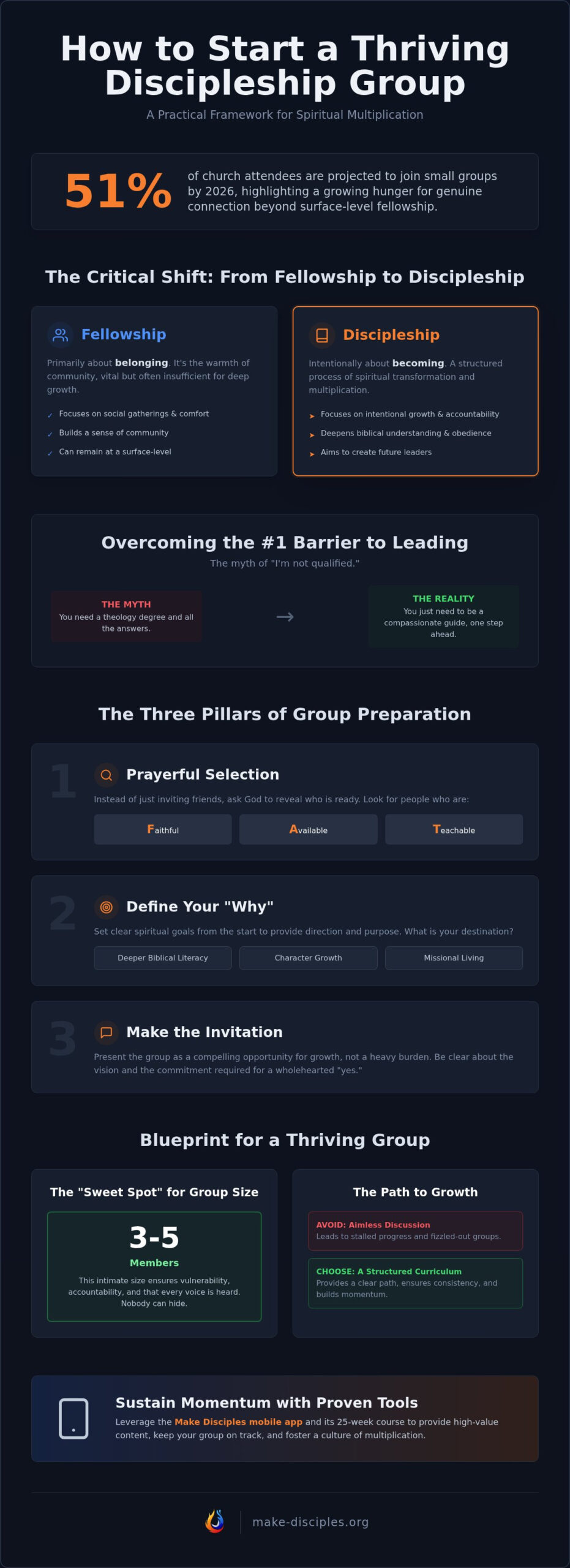
Many groups stall because they mistake fellowship for discipleship. Fellowship is primarily about belonging; it’s the warmth of community and shared meals. While fellowship is vital, discipleship is about becoming. It’s the intentional process of spiritual transformation and growth. To see real change, you must pivot from social gatherings to intentional growth environments. This shift requires a plan and a commitment to hold one another accountable to the Word. If you’re looking for a roadmap for this transition, check out our How to Make Disciples: Step-by-Step Guide for 2026.
Overcoming the ‘I’m Not Qualified’ Myth
The biggest barrier to leadership is the feeling that you aren’t “holy” or “smart” enough. You don’t need to be a professor to lead a group. You just need to be a compassionate guide who is one step ahead of those you’re leading. Your role is to be a fellow traveler who points the way, not an expert with all the answers. Focus on the core qualities of a disciple maker like humility, availability, and a genuine love for others. When you understand how to start a discipleship group, you realize that your willingness to be used by God is your most important qualification.
The Three Pillars of Group Preparation
Success begins long before the first person arrives at your door. When considering how to start a discipleship group, you must build on a solid foundation. This preparation phase isn’t about being perfect; it’s about being intentional. By focusing on three specific pillars, you create a space where spiritual multiplication can actually happen. This process transforms a casual gathering into a life-changing mission that lasts far beyond the initial excitement.
The first pillar is prayerful selection. Instead of simply inviting your closest friends or the people you find most comfortable, ask God to reveal who is truly ready for this journey. Intentional selection means looking for F.A.T. people, which stands for those who are Faithful, Available, and Teachable. These individuals may not have all the answers, but they have the heart to learn and the time to commit. The second pillar involves defining your “why.” Set clear spiritual goals from the start. Are you aiming for deeper biblical literacy, character growth, or missional living? Knowing your destination helps everyone stay the course when life gets busy. Finally, the third pillar is the invitation. Present the group as an opportunity for growth rather than a heavy burden. Be clear about the commitment and the vision so people can say a wholehearted “yes” to the journey ahead.
Identifying the Right Participants
Size matters when you’re building deep spiritual roots. While church small groups often balloon to a dozen people, discipleship groups thrive when they stay intimate. A group of 3 to 5 people is often the “sweet spot” for vulnerability and real accountability. In a group this size, nobody can hide, and everyone has a voice. Look for spiritual hunger over extensive spiritual knowledge. You aren’t looking for experts; you’re looking for people who are thirsty for more of Jesus. Keep an eye out for potential leaders within the group from day one. Your goal is to see these members eventually lead their own groups, continuing the cycle of multiplication that Jesus started.
Setting the Logistics for Success
The environment you choose sets the tone for your meetings. Whether you meet in a quiet cafe, a living room, or a digital space, ensure it’s a place where people feel safe to share. Consistency beats intensity every time. It’s better to meet for 90 minutes every week than for four hours once a month. Your role as the leader is to be a facilitator of conversation, not a lecturer. You don’t need to have all the answers. Using a guide for how to lead a small group discussion can help you keep the conversation focused and productive. If you’re feeling overwhelmed by the planning, the Make Disciples app offers a structured path to keep you on track without the stress of “winging it” every week.
Selecting Your Path: Structured Curriculum vs. Open Discussion
Deciding on the format of your meetings is one of the most critical decisions you’ll make when learning how to start a discipleship group. Many new leaders are tempted to “wing it” by relying on open discussion, believing it feels more organic and less like a classroom. However, without a clear plan, groups often drift into aimless chat that lacks spiritual depth. While social connection is good, it isn’t the same as intentional growth. Without a roadmap, you might find that after six months, your group has enjoyed many coffees but hasn’t actually moved closer to the goal of spiritual multiplication.
Book studies can spark great conversations, but they often focus more on an author’s thoughts than on active obedience. Bible-only studies are foundational, yet they can be intimidating for those who haven’t yet built strong study habits. A structured course, like the Make Disciples 25-Week Discipleship Course, offers a balanced roadmap for total spiritual transformation. It provides the necessary scaffolding to start a discipleship group with friends while ensuring you don’t miss the essential “how-to” of the Christian life. This balanced approach ensures that every meeting has high-value content that leads to action. As disciple making in 2026 continues to evolve, leveraging structured frameworks alongside modern tools is becoming the standard for effective lay-led groups.
Why a Structured 25-Week Framework Works
A 25-week framework provides a clear psychological finish line. New members are more likely to commit when they know exactly how long the journey lasts and what the destination looks like. This comprehensive approach covers ministry skills training that many topical studies overlook, such as how to share your faith or lead others. For the leader, this structure is a gift. It removes the weekly stress of deciding what to talk about, which significantly reduces the risk of leader burnout and keeps the momentum high.
Integrating Digital Discipleship Tools
Modern ministry requires modern tools. A discipleship training app serves as a mentor in your pocket, keeping members engaged between your weekly meetings. Instead of carrying around bulky paper manuals, your group can access mobile training, track their growth with digital checklists, and share resources instantly. This digital integration ensures that the lessons learned on Tuesday night continue to influence their lives on Friday morning. By leveraging these tools, you make the process of how to start a discipleship group accessible to anyone with a smartphone and a willing heart.
Launching Your Group: The First Meeting and the Covenant
The first time your group gathers, the atmosphere should feel like a warm invitation rather than a formal classroom. This initial meeting is where your theoretical planning becomes a living reality. When you’re learning how to start a discipleship group, the launch is your opportunity to set the culture of the community. You aren’t just starting a study; you’re beginning a journey of shared life and spiritual investment. By being intentional from the very first minute, you remove the “what now?” anxiety that often plagues new groups.
Start by casting a clear vision. Paint a vivid picture of what the next 25 weeks will look like and who you hope to become by the end. Next, introduce the group covenant. These are the guardrails for confidentiality, attendance, and homework that protect the group’s health. Third, lead the way by sharing your “faith story.” When you show vulnerability first, you give others permission to do the same. Finally, set the expectation for multiplication. Mention early and often that this group is meant to eventually birth others. This keeps the focus outward and prevents the community from becoming a closed circle.
Creating a Safe and Authentic Environment
Adopting a “Missionary Mentor” approach means you lead with humility. Be the first to share a personal struggle or a question you’re still wrestling with. This removes the pressure for others to act like they have it all together. If you’re wondering how to disciple new believers, remember to keep the language accessible. Avoid heavy theological jargon that might make a newcomer feel out of place. Manage group dynamics with grace by gently drawing out the silent member and kindly redirecting the talkative one. Your goal is to ensure every voice is heard and every person feels valued.
The Power of a Written Covenant
Verbal agreements are easily forgotten when life gets busy. A written covenant serves as a physical reminder of the commitment you’ve made to one another. Include clear policies on attendance, prayer commitments, and your shared multiplication goal. Don’t present this as a list of legalistic rules. Instead, frame the covenant as a tool for freedom. It provides the structure that allows deep relationships to flourish without the constant need to renegotiate expectations. When everyone knows the “rules of the road,” they can focus entirely on the mission of growing together. To help you get started, you can download a sample covenant through the Make Disciples app to use in your first session.
Sustaining Momentum with the Make Disciples App
The biggest challenge in learning how to start a discipleship group isn’t just the launch; it’s keeping the fire burning month after month. Many groups start with high energy but slowly lose focus as life gets busy. This is where the Make Disciples mobile app becomes your most valuable partner. Think of it as a “mentor in your pocket” that provides the scaffolding your group needs to thrive. It removes the heavy lifting of preparation, allowing you to focus on building authentic relationships and listening to the Holy Spirit. By using a digital tool designed for the modern world, you bridge the gap between ancient spiritual goals and your daily reality.
The app features our signature 25-week discipleship course, ensuring that every meeting you host is packed with high-value content. You don’t have to worry about the conversation drifting into aimless small talk because the path is already laid out for you. Beyond the curriculum, the App Manual serves as a training ground for your members. It equips them with the same skills you are using, making the transition from a group of learners to a team of active disciple-makers feel natural and achievable. This intentionality ensures that your group doesn’t just exist for its own sake but becomes a hub for spiritual multiplication.
Practical Ministry Training for Everyday Christians
We believe that everyday Christians are the primary drivers of the Great Commission. The app facilitates evangelism training and outreach skills through simple, actionable steps. You can use the progress tracking features to celebrate spiritual milestones together, which builds a sense of shared victory. If a member has a busy week or travels, the self paced ministry training options ensure they stay connected to the group’s rhythm. This flexibility prevents people from falling behind and keeps the collective momentum moving forward.
From One Group to a Movement
Your group is a seed designed to grow into a forest. These digital discipleship tools enable rapid multiplication across your entire community. As your members grow in confidence, they’ll see how accessible the process is and feel empowered to launch their own groups using the same app and framework. This is how a single gathering of three people can spark a movement that reaches hundreds. You have the tools, the plan, and the calling. Now is the time to act. Start your journey as a disciple-maker today with the Make Disciples App!
Step Into Your Calling as a Disciple-Maker
Starting a journey toward spiritual multiplication is one of the most rewarding steps you’ll take in your walk with Christ. You’ve seen that how to start a discipleship group isn’t about having a theology degree but about being a faithful, available, and teachable guide. By establishing a clear group covenant and following a structured path, you create a safe space where real transformation happens. You don’t need to be a professor to make a global impact; you just need a willing heart and the right tools to lead others well.
Our resources are specifically designed for everyday Christians who want to move past the fear of inadequacy. The Make Disciples platform provides a 25-week structured curriculum and a comprehensive App Manual to support you every step of the way. Stop waiting for the perfect moment to lead and start building the vibrant community you’ve been longing for. Equip your group with the Make Disciples Mobile App today! Your commitment to the Great Commission starts with a single step, and we’re honored to partner with you on this journey.
Frequently Asked Questions
How do I choose the right people for my discipleship group?
Look for people who are Faithful, Available, and Teachable (F.A.T.). When you’re learning how to start a discipleship group, prioritize spiritual hunger over religious knowledge. Ask God to reveal those who are ready for a deeper commitment. It’s often better to start with three people who are truly hungry for growth than ten who are just curious. Focus on individuals who show a desire to obey what they learn and eventually invest in others.
What should we do if someone consistently misses meetings?
Address attendance issues by revisiting your group covenant with grace and sincerity. If someone consistently misses meetings, have a private, gentle conversation to see if their current season of life allows for this commitment. Remind them that their presence is vital for the group’s health and their own growth. If they can’t commit right now, bless them and keep the door open for a future group when their schedule is more available.
Do I need to be an expert in the Bible to start a group?
You don’t need a seminary degree or expert status to lead a group effectively. Your primary role is that of a compassionate guide, not a professor. By using the Make Disciples mobile app and its 25-week curriculum, the “what” of your meetings is already handled. This allows you to focus on facilitating honest conversation and modeling a life of obedience. Your willingness to learn alongside others is often your greatest leadership asset.
How long should a discipleship group meeting last?
Aim for a meeting duration of 60 to 90 minutes to keep the energy high and respect everyone’s time. Consistency is much more important than the length of any single session. A shorter, focused meeting that follows a clear structure usually leads to better engagement than a three-hour marathon. Ensure you leave enough time for both deep study and personal prayer, but always try to end on time to honor the group’s commitment.
What is the difference between a Bible study and a discipleship group?
A Bible study often focuses primarily on gaining information, while a discipleship group focuses on transformation and obedience. While both involve Scripture, a discipleship group is specifically designed for spiritual multiplication. The goal isn’t just to learn what the Bible says but to apply it to daily life and train others to do the same. This intentional focus on “becoming” rather than just “knowing” is what builds a movement of disciple-makers.
How do we handle confidential or sensitive information shared in the group?
Protect the safety of your group by establishing clear confidentiality rules in your written covenant from the first meeting. Remind members regularly that what is shared in the circle stays in the circle. This creates an environment of trust where people feel free to share their real struggles without fear of judgment. If a sensitive situation arises that requires professional help, encourage the individual to seek appropriate pastoral or professional support outside the group.
What happens when the 25-week course is finished?
The completion of the 25-week course marks the beginning of a new chapter of multiplication. Ideally, your group members will feel equipped to step out and lead their own groups using the same tools and curriculum. You move from being a group of learners to a team of active disciple-makers. This transition is the ultimate goal of knowing how to start a discipleship group, as it ensures the Gospel continues to spread through new communities.
Can I start a discipleship group online instead of in person?
You can absolutely start a group in a digital space using video calls and mobile tools. The Make Disciples app is designed to be a “mentor in your pocket,” making it easy to track progress and share resources regardless of physical location. Online groups offer flexibility for those with busy schedules or limited mobility. The key is to maintain the same level of intentionality and vulnerability that you would provide in a face-to-face setting.