

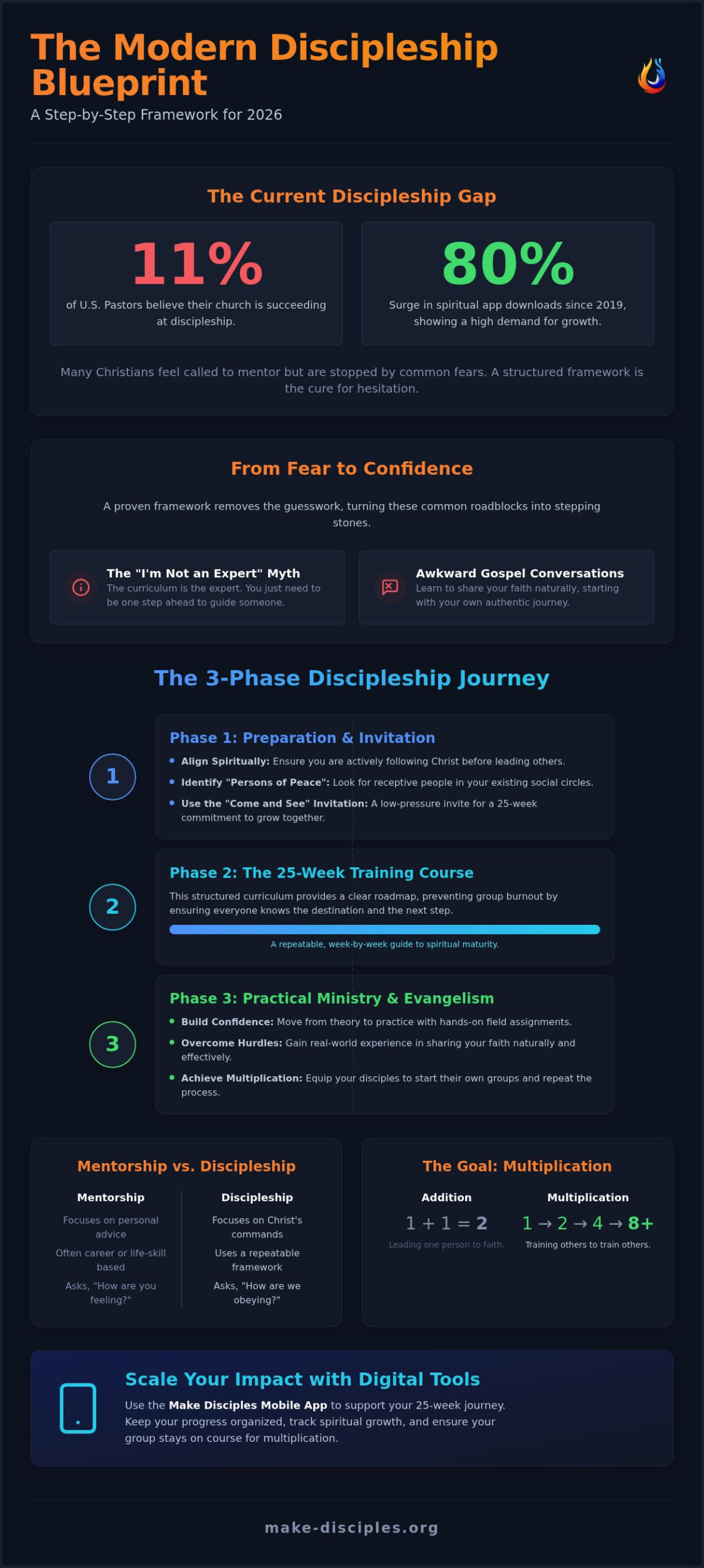
Did you know that discipleship ranks last among what U.S. Protestant pastors believe their churches do best? Only 11% feel they are truly succeeding in this mission. This gap exists even as spiritual app downloads have surged by nearly 80% since 2019. Many believers feel a deep call to mentor others but find themselves paralyzed by the fear of awkward gospel conversations or the feeling that they aren’t expert enough. If you have ever felt ill-equipped to lead, you are certainly not alone. You need a reliable, step by step discipleship training framework that removes the guesswork and builds your confidence.
We believe that making disciples should be accessible to every Christian, not just those with a degree. This article promises to move you from hesitation to action by mastering a repeatable, 25-week framework designed for 2026. You’ll learn how to sustain a group without it fizzling out and how to use digital tools to keep your progress organized. We’re going to walk through a clear roadmap, essential evangelism skills, and the practical steps to help you start making disciples who make disciples today.
Key Takeaways
- Understand why a structured roadmap is the essential cure for group burnout and moving past vague spiritual intentions.
- Learn how to identify “Persons of Peace” within your current social circles to find those who are ready for a deeper journey.
- Master a repeatable step by step discipleship training framework that guides you from the first invitation to full spiritual multiplication.
- Overcome the fear of “not knowing enough” through practical field assignments designed to build your evangelism confidence.
- Use digital tools like the Make Disciples Mobile App to track spiritual growth and keep your 25-week process organized and measurable.
Why a Structured Step-by-Step Discipleship Training Framework is Essential
Discipleship isn’t a vague spiritual hobby; it’s a purposeful journey toward maturity. A step by step discipleship training framework provides the necessary structure to move from good intentions to actual results. Without a roadmap, most spiritual groups fizzle out within three weeks because they lack a clear destination. By following a systematic approach, you transition from being a passive consumer of Sunday sermons to an active participant in the Great Commission. This structure isn’t about legalism; it’s about creating a sustainable rhythm that respects your time and honors your commitment to growth.
The ultimate goal of this framework is multiplication rather than simple addition. Addition happens when you lead one person to faith. Multiplication occurs when you train that person to lead others, who then lead others. This exponential growth is how the early church transformed the world. To understand the root of this mission, it helps to ask: What is a Disciple? Historically, it means much more than being a student; it means being a devoted follower who reproduces the life and teachings of their teacher in every aspect of their existence.
The Difference Between Mentorship and Discipleship
Mentorship often focuses on personal advice, career coaching, or life skills. While these are helpful, they aren’t discipleship. True discipleship focuses on following Christ’s commands through a repeatable framework. It moves beyond “how are you feeling?” to “how are we obeying?”. A training framework ensures the focus remains on biblical growth rather than just sharing personal opinions. We aim to help you become a “Level 5” disciple-maker. This is someone who doesn’t just lead a group, but lives a life worth imitating and empowers others to start their own groups.
Overcoming the “I Am Not an Expert” Myth
You don’t need a seminary degree or a title to lead someone else. You only need to be one step ahead of the person you are training. When you use a proven curriculum, the materials act as the “expert” in the room. This frees you to focus on building a genuine relationship and offering encouragement. Learning how to grow in ministry is possible for every everyday Christian when they have the right tools in hand. A structured framework provides the safety net needed for long-term consistency. It turns a daunting task into a series of manageable milestones. When you know exactly what to do next, the fear of failure fades, allowing you to focus on the person in front of you.
Phase 1: Preparation and the Invitation to Follow
Effective step by step discipleship training begins long before your first meeting. It starts with your own spiritual alignment. Before you ask someone else to follow you, ensure you are actively following Christ. Spend time in prayer, asking for clarity on who you should invest in. This isn’t about finding the “perfect” person, but about identifying “Persons of Peace” in your existing circles. These are individuals who are open to your presence, receptive to your message, and ready to share what they learn with others. Look for the neighbor, colleague, or friend who already shows a spark of spiritual curiosity.
Once you identify a potential disciple, use the “Come and See” invitation. This is a low-pressure way to invite someone into a shared journey. Be transparent from the start. Explain that this is a 25-week commitment to grow together. Setting these expectations upfront prevents the “fizzle-out” factor mentioned earlier. While some formal institutions offer a structured discipleship training program for academic credit, our framework focuses on the practical, everyday application of faith in the real world. You don’t need a certificate to start; you just need a willing heart and a clear plan.
Starting Gospel Conversations Naturally
The biggest hurdle for most believers is the transition from weather talk to soul talk. You don’t need to be a theologian to share your faith. Start by being authentic about your own journey. Use simple phrases like, “I’ve been learning something lately that really changed how I view my stress,” or “I’m starting a group to look at what Jesus actually taught, would you be interested?”. If you feel stuck, reviewing specific evangelism training can give you the confidence to navigate these moments without the “awkward” feeling. Remember, you aren’t selling a product. You’re offering a relationship with the Creator.
Building the Discipleship Environment
Where you meet matters. A neutral coffee shop is great for initial “Come and See” conversations because it feels safe and casual. As the relationship deepens, moving to a living room can foster more vulnerability and “warm hospitality.” Your goal is to establish a rhythm of grace, truth, and time. Grace provides the safety to fail, truth provides the direction to grow, and time allows for genuine transformation. To keep these elements balanced, many mentors find it helpful to use the Make Disciples Mobile App as a central hub for resources and scheduling. This ensures the environment remains focused on the mission rather than administrative details.
Phase 2: Implementing the 25-Week Discipleship Training Course
Execution is where many spiritual intentions fail, but a step by step discipleship training framework provides the guardrails you need to succeed. The 25-week journey is designed to move a person from foundational understanding to active ministry leadership. To keep the momentum, structure your weekly meetings to last between 60 and 90 minutes. This timeframe is long enough for depth but short enough to respect busy schedules. A healthy session should follow a simple three-part rhythm:
- Connect (20 mins): Share life updates and review the previous week’s obedience. This builds the life-to-life sharing essential for genuine growth.
- Study (40 mins): Engage with the Word using inductive methods like S.O.A.P. (Scripture, Observation, Application, and Prayer). This empowers the student to hear from God directly rather than relying on your expertise.
- Apply (20 mins): Set a specific, measurable goal for the coming week. Discipleship is about “doing” the Word, not just “knowing” it.
Balancing lesson content with personal sharing is vital. If you only focus on the curriculum, you have a classroom. If you only focus on sharing, you have a support group. Effective training requires both. By using a consistent structure, you ensure that every meeting moves the needle toward spiritual maturity.
Weeks 1-8: Establishing the Biblical Foundation
The first two months are the most critical. During this phase, focus heavily on identity in Christ and the assurance of salvation. You aren’t just teaching facts; you are helping someone anchor their soul in the gospel. We prioritize “doing” early on by encouraging students to share what they learn with one other person immediately. Following the structure of a high-quality online discipleship course helps you stay on track during these foundational weeks. This ensures you don’t spend too much time on minor theological debates while neglecting the core habits of a follower of Jesus.
Weeks 9-25: Developing Ministry Skills
Once the foundation is set, the focus shifts outward. In these weeks, you transition from being the primary teacher to being a coach. Practical exercises are the centerpiece of this phase. You will help your student craft and share their personal testimony, learn how to pray for others in public, and engage in basic apologetics. By week 20, the student should begin leading parts of the meeting themselves. The goal is that by week 25, they are ready to identify their own “Person of Peace” and begin the process again. This is where simple addition turns into the power of multiplication.
Phase 3: Practical Ministry and Overcoming Evangelism Hurdles
The transition from sitting in a living room to active ministry is where the real growth happens. However, this is also where most people hit a wall. The primary barrier isn’t a lack of knowledge; it’s the paralyzing fear of social rejection or the worry that they won’t be able to answer a difficult question. In a healthy step by step discipleship training framework, we address these fears through modeling. You shouldn’t expect a student to do something you haven’t shown them how to do yourself. If you want them to pray for a stranger or start a spiritual conversation, they need to see you do it first in a natural, low-pressure way.
When difficult questions arise, don’t feel pressured to be a walking encyclopedia. One of the most powerful things you can say is, “I don’t know the answer to that, but let’s look for it together next week.” This humble approach actually builds more trust than a rehearsed, academic answer. It shows your student that they don’t have to be an expert to be a disciple-maker. Practical field assignments, such as simply asking a neighbor how you can pray for them, help build “evangelism muscles” in small, manageable increments.
Navigating the Fear of Sharing the Gospel
We often view evangelism as a high-stakes debate where we have to “win.” Instead, try reframing it as sharing a wonderful gift. You aren’t forcing a product; you’re offering hope to someone who might be hurting. Use everyday moments to practice low-pressure outreach. This could be as simple as mentioning your church community or sharing how a specific verse helped you during a stressful week. For those who feel stuck on what to say, our how to make disciples guide provides specific scripts and transition phrases that feel natural rather than forced.
From Mentorship to Multiplication
The goal of discipleship is to move from being a mentor to seeing your student become a mentor to someone else. We use the “I Do, We Do, You Do” model to facilitate this transfer of skills. First, the student watches you lead. Next, you lead together. Finally, they lead while you observe and offer encouragement. This progression ensures the chain of discipleship doesn’t break. You know a student is ready to lead their own group when they can consistently apply the foundation and are eager to share it with others. To start this process with your own group, you can download the 25-Week Discipleship Course and begin identifying your first “Person of Peace” today.
Scaling Your Impact with Digital Discipleship Tools
Modern ministry requires modern solutions. While the heart of discipleship is deeply relational, the organization of a 25-week journey can be complex without the right support. Utilizing technology ensures that your step by step discipleship training remains consistent, measurable, and accessible. Digital tools don’t replace the mentor; they empower the mentor to focus on the person rather than the paperwork. In 2026, spiritual app downloads have risen nearly 80% since 2019, showing that people are already looking to their devices for spiritual guidance. By meeting them where they are, you lower the barrier to entry and increase the likelihood of long-term success.
Using digital tracking allows you to monitor spiritual growth and consistency without being overbearing. It provides a shared space to review obedience goals and prayer requests, ensuring that nothing falls through the cracks between weekly meetings. This level of organization is especially helpful when you begin to lead multiple groups or when your students start training others. It turns a manual process into a scalable movement that can reach far beyond your local circle.
The Make Disciples Mobile App Advantage
The Make Disciples Mobile App acts as a digital companion for both the trainer and the student. It provides instant access to the full 25-week curriculum, allowing for study and reflection anytime, anywhere. Interactive features encourage daily engagement, which is crucial for building the spiritual habits discussed in Phase 2. Unlike static PDFs or eBooks, this platform facilitates real-time tracking of personal goals and obedience steps. This keeps the mission front and center throughout the week. For a deeper look at how to select the right platform for your ministry, see our discipleship training app pillar for a full feature breakdown.
Implementing the Official App Manual
Scalability is the key to multiplication. If you want to see your church transition from a few mentors to a movement of disciple-makers, you need a way to train other leaders effectively. The Official App Manual is designed for this exact purpose. It provides a step-by-step setup for small group digital integration, ensuring that every leader in your community uses the same framework. This consistency prevents the “fizzle-out” factor by providing a clear technical roadmap alongside the spiritual one. Leveraging digital discipleship tools allows your ministry to maintain a global reach, connecting with believers regardless of their linguistic or cultural background. Reaching the next generation requires this tech-savvy approach, as younger believers expect their spiritual growth tools to be as intuitive as the rest of their digital lives. By integrating these tools into your step by step discipleship training, you show that the Great Commission is as relevant today as it was 2,000 years ago.
Take Your Next Step in the Great Commission
You’ve seen how a clear roadmap can transform your fear of ministry into a confident, life-changing mission. By moving from vague intentions to a structured 25-week journey, you can overcome the common “fizzle-out” factor and start making disciples who make disciples. This framework isn’t reserved for experts with theological degrees. It’s designed specifically for everyday Christians who are ready to say “yes” to the call of Jesus in their daily lives.
Implementing a step by step discipleship training plan provides the practical guardrails you need to stay consistent. Our 25-Week Structured Curriculum and the included Official App Manual give you the confidence to lead a group from spiritual foundation to multiplication. You don’t have to feel ill-equipped or overwhelmed by the task anymore.
Download the Make Disciples App and Start Your 25-Week Journey Today.
The tools are ready, and the people in your life are waiting for an invitation. Take heart, start where you are, and watch how your obedience facilitates a global movement of faith. You were made for this journey.
Frequently Asked Questions
What is the first step in starting a discipleship relationship?
The first step is spiritual preparation through prayer followed by identifying a “Person of Peace” in your social circle. This is someone who is open, receptive, and ready to share what they learn. Instead of looking for a perfect student, look for a willing one. Once identified, offer a simple “Come and See” invitation. This low-pressure approach establishes a foundation of trust and transparency from the very first interaction.
How long does a typical discipleship training course take?
A typical course duration varies, but our framework specifically utilizes a 25-week structured journey. This timeframe allows enough room to establish a firm biblical foundation while transitioning into practical ministry skills. Breaking the process into 25 weeks prevents the “fizzle-out” factor by providing a clear, manageable roadmap. It ensures that the relationship has enough time to move from initial mentorship to the ultimate goal of spiritual multiplication.
Do I need a theology degree to use the 25-week discipleship course?
You absolutely don’t need a theology degree to lead others through this course. Make Disciples specializes in equipping everyday Christians for ministry by providing a curriculum that acts as the “expert” in the room. This allows you to focus on the relationship and personal encouragement rather than academic lecturing. We believe every believer has the capacity to make disciples when they have access to a clear, practical framework.
Can I use a mobile app for effective discipleship training?
Yes, using a mobile app is one of the most effective ways to manage step by step discipleship training in a modern context. The Make Disciples Mobile App streamlines the 25-week journey by providing curriculum access and growth tracking in one place. Digital tools help keep the process organized and ensure that daily engagement continues between your weekly meetings. This tech-savvy approach is especially vital for reaching and engaging the next generation.
What should I do if my disciple stops showing interest?
If a disciple loses interest, start by having an honest and graceful conversation to identify any personal or spiritual barriers. Sometimes life circumstances create temporary hurdles that require a rhythm of grace and patience. However, if the disinterest persists, it’s okay to pause the formal training. Discipleship requires a willing heart. You can continue the friendship while looking for another “Person of Peace” who is ready for a deeper commitment.
How do I balance teaching the Bible with practical ministry skills?
Balancing these elements requires a consistent meeting rhythm, such as the Connect-Study-Apply model. Spend the first portion of your time sharing life updates, the middle portion on inductive Bible study like S.O.A.P., and the final portion on practical ministry goals. This structure ensures that you aren’t just transferring information but are actively building ministry skills. Discipleship is about becoming an active participant in the Great Commission, not just a passive consumer.
Is the Make Disciples app suitable for small group training?
The Make Disciples app is perfectly suited for small group training, especially when paired with the Official App Manual. The manual provides a setup guide for integrating digital tools into a group setting. This ensures that every leader in your church or community uses a consistent framework. Using the app within a small group allows for shared tracking of goals and prayer requests, which fosters a sense of community and collective accountability.
How do I handle difficult theological questions during a session?
When faced with a difficult question, maintain your confidence by being humble and honest. You don’t need to have all the answers to be an effective mentor. Simply state that you don’t know the answer but would love to research it together before the next session. This modeling shows your student that they don’t have to be an expert to lead others. It turns a potential hurdle into a collaborative learning opportunity.