

What if the only thing standing between you and fulfilling the Great Commission isn’t a lack of theological training, but simply the lack of a clear starting point? Most Christians feel a deep desire to mentor others, yet they’re often paralyzed by the fear of being asked a question they can’t answer. It’s completely normal to feel anxious about initiating spiritual conversations when you don’t have a structured roadmap to follow. Learning how to make disciples shouldn’t feel like a high-stakes exam you’re destined to fail. It is a relational journey that starts with a willing heart and a few simple, effective tools.
You already have what it takes to lead others toward Jesus. In this guide, you’ll discover the biblical principles and practical steps needed to confidently mentor a new believer, even if you’ve never done it before. We’ll walk through a clear framework for 2026 that simplifies the process and removes the guesswork. From initiating that first conversation to using modern resources that support long-term spiritual growth, you’ll gain the clarity you need to move from a passive observer to an active participant in God’s global mission.
Key Takeaways
- Embrace your role as a compassionate guide rather than a theological expert to fulfill the Great Commission in your daily life.
- Identify potential disciples within your existing social circles and prepare your heart through intentional, focused prayer.
- Implement a simple four-step process of teaching, modeling, correcting, and loving to help others grow authentically in their faith.
- Discover how to make disciples confidently by overcoming the common fears of awkwardness or not having all the answers.
- Utilize structured tools like a 25-week curriculum to provide a clear roadmap that sustains long-term spiritual development.
Understanding the Heart of Disciple-Making
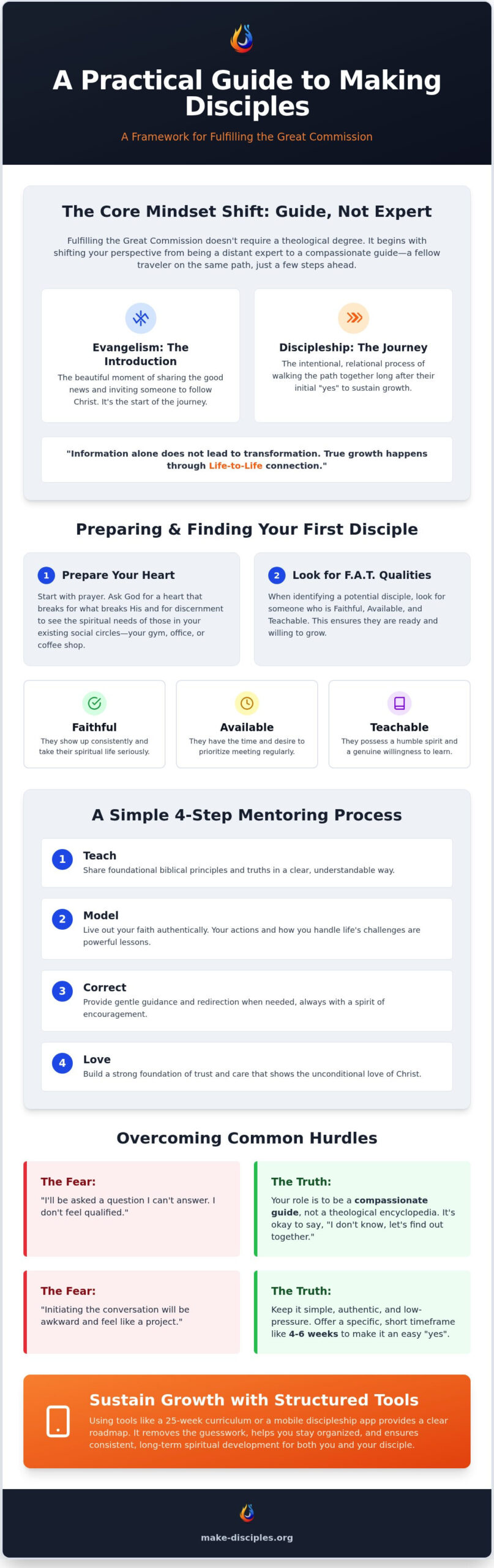
To understand how to make disciples, we first need to strip away the idea that you need a master’s degree in divinity or years of formal training. Think of yourself as a compassionate guide rather than a distant expert. You aren’t standing on a pedestal looking down. Instead, you’re walking a trail and simply pointing out the path you’ve already traveled. It’s about being a fellow traveler who’s a few steps ahead, offering a hand to those coming behind you.
The foundation of this mission is the Great Commission. In Matthew 28:18-20, Jesus provides the ultimate mandate: “All authority in heaven and on earth has been given to me. Therefore go and make disciples of all nations, baptizing them in the name of the Father and of the Son and of the Holy Spirit, and teaching them to obey everything I have commanded you.” This wasn’t a suggestion for a select group of “professional” Christians or clergy. It’s a direct command for every believer to participate in God’s global plan.
It’s also vital to distinguish between evangelism and discipleship. Evangelism is the act of sharing the good news and inviting someone to follow Christ. It’s the beautiful moment of introduction. Discipleship, however, is walking the path together long after that first “yes.” While evangelism starts the journey, discipleship sustains it through consistent, intentional relationship.
What is a Disciple of Christ?
A disciple is simply a learner and a follower who seeks to be like their teacher. In the biblical context, this requires a shift from being a passive observer in a pew to an active participant in the Kingdom. You don’t have to be perfect to start. In fact, waiting for perfection is the fastest way to stay stagnant. Focus on becoming a person who follows Jesus’ commands, and you’ll naturally find yourself equipped to lead others. Your growth is the fuel for theirs.
Why Discipleship is Relational, Not Just Educational
Information alone does not lead to transformation. You can memorize facts about the Bible without ever letting them change your heart. True growth happens through “Life-to-Life” connection. This means sharing your daily life, your struggles, and your victories, not just your study notes. Be authentic. Be vulnerable. When you show someone how you actually handle a difficult day or a spiritual doubt, you provide a living example of faith in action. This relational approach is how to make disciples who stay the course for a lifetime.
Preparing Your Heart and Finding Your First Disciple
Before you take a single step toward someone else, you must first look inward. Success in learning how to make disciples depends entirely on your spiritual posture. Start by asking God for a heart that breaks for what breaks His. Pray for discernment to see the people around you not just as coworkers or neighbors, but as individuals with deep spiritual needs. This internal preparation shifts your focus from your own insecurities to the actual needs of the person in front of you.
Once your heart is ready, look at your existing circles. You don’t need to fly across the world to find a mission field. Look at your gym, your office, or your local coffee shop. When identifying a potential disciple, look for the “F.A.T.” qualities. You want someone who is:
- Faithful: They show up and take their spiritual life seriously.
- Available: They have the time and desire to prioritize meeting.
- Teachable: They possess a humble spirit and a willingness to learn.
The Role of Prayer in Disciple-Making
Prayer is the engine of the Great Commission. Ask for divine appointments where God naturally opens a door for a conversation. Don’t rely on your own charisma or Bible knowledge. Instead, cultivate a constant dependence on the Holy Spirit to give you the right words at the right time. Commit to praying for your future disciple daily, even before you know their name. This builds a foundation of love that will sustain the relationship through the natural ups and downs of spiritual growth.
How to Initiate the Conversation
The “ask” is often where most people get stuck. Keep it simple and authentic. Avoid using heavy religious jargon that might make the other person feel like a project. Instead, be clear about the purpose and the commitment. You might say, “I’ve been learning some things about following Jesus that have really helped me, and I’d love to share them with you. Would you be open to grabbing coffee once a week for a few weeks to talk about it?”
Offering a specific timeframe, like four to six weeks, reduces the pressure and makes it easier for them to say yes. If you’re feeling unsure about how to lead those sessions, using a mobile discipleship tool can help you stay organized and focused during your meetings. Remember, your goal isn’t to be a perfect teacher. You are simply a faithful friend who points the way toward the truth. By keeping the invitation low-pressure and relational, you create a space where a new believer feels safe to grow and ask questions.
The 4-Step Process: Teach, Model, Correct, and Love
Once you’ve made the “ask” and found a willing partner, the real work begins. Understanding how to make disciples effectively involves a repeatable process that balances truth with relationship. This isn’t about delivering a lecture. It’s about inviting someone into the rhythm of your life. The four pillars of this process are teaching, modeling, correcting, and loving. When these four elements work together, they create a safe environment where spiritual growth becomes natural rather than forced.
Teaching focuses on sharing the commands of Jesus in a way that’s easy to grasp. Don’t feel pressured to have an answer for every complex theological debate. Simply focus on what Jesus said and how it applies to daily life. However, teaching alone is insufficient without love. Genuine care is the foundation that makes every other step effective. If your disciple doesn’t feel loved, your teaching will sound like noise and your correction will feel like an attack.
Modeling the Christian Life
By letting someone watch you live, you provide a roadmap for their own faith. Invite your disciple into your “normal” world. This could be a family dinner, a trip to the hardware store, or a session of ministry work. Show them, don’t just tell them, how you navigate a frustrating situation or how you initiate a gospel conversation with a stranger. When they see your consistent prayer life in real-time, the concept of faith moves from an abstract idea to a tangible reality. It’s about being an example they can actually follow.
Correction with Grace and Humility
Correction is often the part of how to make disciples that people fear most. To do this well, you must maintain the posture of a “Missionary Mentor” rather than a judge. Frame correction as a mutual effort to follow Jesus more closely. Use Scripture as the ultimate authority for your guidance, making it clear that you aren’t just sharing a personal opinion. When you correct with humility, you show that you’re also under the authority of God’s Word. This builds trust and keeps the relationship focused on Christ rather than your own preferences.
Overcoming Common Hurdles and the Fear of Evangelism
Many people hesitate to start because they fear being stumped by a difficult question. This is the biggest hurdle in learning how to make disciples. It’s okay to feel awkward. In fact, acknowledging that feeling helps you push through it. You aren’t meant to be a walking encyclopedia of theology. Shift your focus away from your own performance and rely on the Holy Spirit’s power to guide the heart of the listener. Your job is to be faithful, not flawless.
When you encounter a question you can’t answer, don’t panic or fake it. Use a simple framework: validate the question, admit you don’t know the answer yet, and invite them to research it with you. This approach actually builds significant trust. It shows your disciple that you’re a fellow learner, not a distant expert. By admitting your limits, you model the humility and curiosity that every follower of Christ should possess. It turns a potential roadblock into a shared journey of discovery.
Practical Evangelism: Sharing Your Faith Naturally
Move beyond small talk by looking for “spiritual windows” in everyday conversations. Use simple starters like, “I’ve been praying about [situation] lately, do you have anything I can pray for?” Practice sharing your personal testimony in two minutes or less. Focus on your life before Christ, the moment of your “yes,” and the peace you have now. For deeper skills, explore this Evangelism Training to help you navigate these moments with quiet confidence. Keeping it brief and personal makes the conversation feel like a gift rather than a lecture.
Dealing with Resistance or Lack of Interest
Not every invitation will result in a “yes.” If someone shows a lack of interest, remember that a “no” to an invite is not a “no” to you personally. They might be dealing with internal struggles you can’t see. Maintain the friendship without making them feel like a project. If the resistance continues, pivot your energy toward someone else who is “Available and Teachable.” You aren’t giving up on the first person; you’re simply prioritizing the mission where the soil is currently fertile. This persistence is a key part of how to make disciples in a world that often feels distracted.
To help you stay on track through these challenges, access our mobile discipleship app and get the support you need to lead others well.
Using Structured Tools to Sustain Growth
Discipleship often starts with high energy but can quickly stall when you hit the “What do we talk about today?” wall. This fatigue is one of the primary reasons many mentors stop before they see real transformation in others. Using structured tools doesn’t make the relationship less spiritual. Instead, it provides the necessary tracks for the train to run on. When you understand how to make disciples with a clear plan, you spend less time worrying about the agenda and more time focusing on the person sitting across from you.
The 25-Week Discipleship Course serves as a comprehensive roadmap for new mentors. It takes the guesswork out of the process by providing a clear path from the initial stages of faith to active ministry. By having a set curriculum, you ensure that essential biblical foundations aren’t missed. These tools are designed to be your servant, not your master. They empower you to lead with quiet confidence, knowing that you have a proven framework to guide your conversations and keep the momentum moving forward.
The 25-Week Discipleship Framework
This curriculum is specifically built for everyday Christians rather than academic scholars. It follows a logical progression that starts with basic faith foundations and moves toward practical ministry skills. Because the course is self-paced, it adapts to the unique rhythm of your relationship. You don’t have to rush through deep topics; you can linger where your disciple needs the most growth. This structure allows you to fulfill the Great Commission without feeling overwhelmed by the weight of preparation.
Digital Discipleship for the Modern World
We live in a fast-paced society where meeting in person isn’t always possible every week. The Make Disciples Mobile App bridges this gap by keeping resources accessible anywhere. Whether you’re at a coffee shop or on your morning commute, the app ensures that spiritual growth doesn’t have to pause. Utilizing Digital Discipleship Tools allows for consistent engagement between your face-to-face meetings. Technology, when used intentionally, becomes a powerful way to amplify your impact. It helps you stay connected and organized as you learn how to make disciples who will, in turn, go out and reach others.
Start Your Disciple-Making Journey Today
You’ve seen that the call to reach others isn’t reserved for experts or the perfect. It’s a relational journey of walking alongside someone and sharing the truth you’ve already received. By focusing on a “Life-to-Life” connection and following a simple four-step process, you can move past the anxiety of not knowing enough. Learning how to make disciples is simply about being a faithful guide who points others toward Christ while navigating the realities of daily life together.
You don’t have to walk this path without a plan. A structured roadmap removes the pressure and allows you to focus on the person in front of you. Our 25-week practical ministry curriculum is designed specifically for everyday believers and is accessible through an easy-to-use mobile platform. Download the Make Disciples Mobile App and start your 25-week journey today! You already have the most important qualification: a heart that’s willing to say yes. Step out in faith and begin your mission as a compassionate guide.
Frequently Asked Questions
Do I need a theology degree to start making disciples?
You don’t need a formal theology degree to begin. The Great Commission is a mandate for every believer, not just the clergy. Focus on being a fellow traveler who’s a few steps ahead on the path. By using a structured roadmap like our 25-week curriculum, you can lead with confidence without feeling like you need to be a scholar. Your personal experience with Christ and a willing heart are your most important qualifications.
What if the person I am discipling asks a question I can’t answer?
It’s perfectly fine to admit you don’t have all the answers. In fact, saying “I don’t know, let’s find out together” builds significant trust and models humility. This approach turns a difficult question into a shared discovery process. Use your Bible or digital resources to research the topic before your next meeting. This shows your disciple that you’re also a learner who values the authority of Scripture over personal opinion.
How much time per week does a discipleship relationship actually take?
A typical discipleship relationship usually requires about one to two hours for a focused weekly meeting. However, it’s also about integrating that person into your existing life rhythms. This might include a quick text during the week or inviting them to join you for a meal. The goal isn’t to add a heavy burden to your schedule, but to be intentional with the time you already have. Consistency is more important than duration.
What is the difference between a Bible study and a discipleship group?
While both involve Scripture, a Bible study often focuses primarily on gaining information and understanding text. Discipleship is more relational and focuses on transformation and obedience. It’s about learning how to make disciples who can then go and do the same for others. A discipleship group emphasizes “life-on-life” connection and practical application of Jesus’ commands in daily situations. It moves beyond just knowing the Word to actually living it out.
How do I know if someone is ready to be discipled?
Look for the “F.A.T.” qualities: Faithful, Available, and Teachable. A person is ready when they show a consistent desire to grow and are willing to prioritize your meetings. They don’t need to be perfect, but they should have a humble spirit and a hunger for spiritual truth. If someone is consistently making excuses or shows no interest in applying what they learn, they might not be in a season of readiness yet.
Can I disciple someone who is older or more experienced than me?
You can absolutely disciple someone who is older or more experienced than you. Discipleship isn’t about age or social status; it’s about being a faithful guide who shares specific tools and biblical principles. If you have a structured roadmap to follow, your age becomes irrelevant to the process. Many older believers actually appreciate the fresh perspective and intentionality that a younger mentor brings to their spiritual walk. Focus on the mission, not the age gap.
What happens if the discipleship relationship isn’t working out?
If a relationship isn’t working, start with prayer and honest communication. Sometimes a specific season of mentorship naturally comes to an end, or life circumstances change for one of you. Don’t take it personally if someone isn’t ready to commit. It’s better to gracefully end a stagnant relationship so you can pivot your energy toward someone else who is “Available and Teachable.” Maintain the friendship while releasing the formal discipleship structure.
Is it possible to make disciples digitally or online?
Making disciples digitally is not only possible but increasingly common in our modern world. While face-to-face time is valuable, digital tools like a mobile app can bridge the gap between meetings and keep resources accessible anywhere. You can use video calls for your primary sessions and messaging apps to stay connected throughout the week. This approach is an effective way to learn how to make disciples across different time zones or busy schedules.